
 Vendon Cloud
 Use Cases
 Closed loop
 Engine systems
 Card readers
 Loyalty apps
 Cash systems
 About Coges
 Contacts
Every year, someone declares the death of cash. Conference speakers, fintech ads, headlines – they all agree: coins and banknotes are on their way out.
And in June 2026, they finally got their headline.
The Deutsche Bundesbank published its latest study on payment behaviour, and for the first time in German history, cashless payments overtook cash.
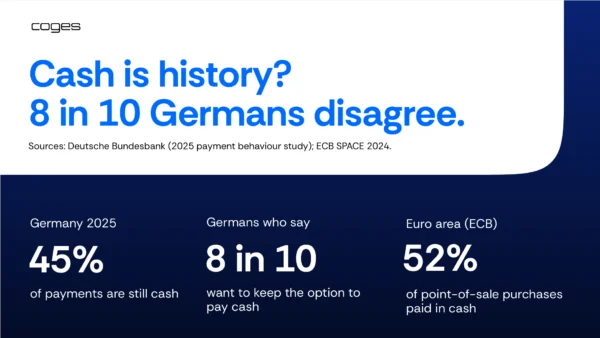
In 2025, 55% of everyday purchases in Germany were paid without cash. Cash dropped to 45% – six percentage points less than just two years earlier.
Case closed? Not quite. Because the same study contains a number the headlines skipped:
Eight out of ten Germans say they want to keep the option to pay with cash.
Read that again. People are using cash a little less – and defending it more strongly than ever.
In an earlier Bundesbank survey, two thirds of the population said they want to keep cash available, and when asked about the future, more than 70% went even further. Usage is slowly declining. Trust is not.
So what’s really going on? And what does it mean for anyone who runs vending machines?
Cash is not nostalgia. It’s a lifeline.
The Bundesbank doesn’t defend cash out of sentiment. Its researchers name concrete reasons why cash must stay part of the payment landscape: it ensures that all segments of the population can participate in the economy, and it offers resilience in a crisis.
Look at who actually depends on cash:
- People with lower incomes.
Bundesbank research has shown a clear pattern for years: the lower the income, the higher the share of cash payments. There’s a simple reason. Cash is the best budgeting tool ever invented. When you have €50 for the week, you can see it, feel it, and divide it. A card never tells you when to stop. For millions of households, paying in cash is not a habit – it’s how they stay in control of their money. - Older and younger people.
The same research shows that people under 25 and over 55 pay in cash more than average. Not everyone has a premium bank account, a credit card, or the newest phone. - People who struggle with digital payments.
The European Central Bank’s SPACE study found that almost one in ten consumers needs assistance when making a digital payment. For them, a coin slot is not old-fashioned. It’s the accessible option. - Everyone, on a bad day.
The card gets declined. The phone battery dies. The mobile network drops in the factory basement. The banking app wants an update. Cash is everyone’s plan B – which is exactly why 8 in 10 refuse to give it up, even as they tap their cards more often.
And access is already getting harder: 15% of Germans now say it’s difficult to reach an ATM, up from just 6% in 2021. The people who depend on cash are the same people being quietly left behind. Every machine that accepts coins properly is, in a small way, keeping the door open for them.
Vending is cash country
Here’s the part that matters for our industry: cash doesn’t decline evenly. It retreats from big purchases and holds its ground on small ones.
The ECB’s euro-area data shows the pattern clearly.
- At supermarkets, cash covers 38% of transactions.
- In small shops, 57%.
The smaller and quicker the purchase, the more people reach for coins.
Now ask yourself: what is a vending purchase? It’s the smallest, quickest transaction in retail. A €1.50 coffee. A €2 snack. Bought in seconds, often by shift workers, students, drivers – exactly the groups where cash is strongest.
Across the euro area, cash is still the single most used payment method at the point of sale, covering 52% of transactions – and the ECB’s survey explicitly includes vending machines in that data.
So while the payments world debates the future, the present at your machines looks like this: roughly every second customer standing in front of them may want to pay with a coin. In Germany, 45 out of every 100. In Austria and Italy, more than 60.
The real risk isn’t accepting cash. It’s accepting it badly.
Here is where the “death of cash” story does real damage. It tempts operators to treat their cash systems as yesterday’s technology – something to tolerate, not maintain.
Meanwhile, German shops set a brutal benchmark. In summer 2025, the Bundesbank ran about 2,060 real test purchases across the country. The result: 99.4% of sales outlets accepted cash, and in 98.7% of cases, the cash payment worked on the first attempt.
That’s the standard your customer is used to. The corner bakery takes their coin, first try, 99 times out of 100.
Now the uncomfortable question: does your fleet match the bakery?
Do the maths on what “almost working” costs. Imagine a machine that makes 60 sales a day, half in cash. If a worn coin mechanism rejects even 5% of coin attempts, and half of those customers give up instead of trying again – that’s roughly one lost sale per machine per day. Nobody complains. Nobody calls. They just walk away, and some of them don’t come back. Across a fleet of 100 machines, that quiet failure adds up to tens of thousands of lost sales a year.
A broken card reader gets fixed within a day, because it feels modern and urgent. A tired coin mech can bleed money for months, because rejected coins don’t generate support tickets.
What “taking cash seriously” looks like in 2026
Respecting cash doesn’t mean going back in time. It means running cash with the same intelligence as digital payments:
High first-time acceptance. Every rejected coin is a customer deciding whether to try again or leave. Acceptance rate is not a technical spec – it’s a sales number.
Connected cash systems. A modern change-giver reports its sales, flags jams before the customer gets angry, and feeds the same dashboard as your card reader. A silent machine at 10 a.m. on a busy site should trigger an alert, not wait for Thursday’s route.
Smart collection. Stop emptying coin boxes on a fixed calendar. Collect when the data says the box value justifies the trip. Know what should be inside before you open it – so any difference is visible immediately.
Both, not either. This was never cash versus cashless. The winning machine says yes to the customer with a coin, the customer with a card, the customer with a phone – and the customer whose phone just died. Every payment method you handle badly is a customer you hand to someone else.
The bottom line
Yes, Germany crossed a symbolic line in 2025. Cashless is now the majority. That trend is real, and pretending otherwise would be foolish.
But the people have voted too, and their answer is clear: 8 in 10 want cash to stay. For lower-income households, for older and younger customers, for one in ten who needs help with digital payments, and for everyone whose card ever failed at the worst moment – cash is not history. It’s trust in physical form.
Vending lives exactly where that trust is spent, one coin at a time. The operators who win won’t be the ones who abandon cash first. They’ll be the ones whose machines simply work – for every customer, with every payment, every time.
When did you last test how well your machines accept coins?
Sources: Deutsche Bundesbank, “Payment behaviour in Germany in 2025” (June 2026); Deutsche Bundesbank, cash acceptance test-purchase study, Monthly Report (December 2025); European Central Bank, SPACE 2024 (December 2024).