
 Vendon Cloud
 Use Cases
 Closed loop
 Engine systems
 Card readers
 Loyalty apps
 Cash systems
 About Coges
 Contacts
If you manage vending machines from different suppliers, with different payment systems, telemetry tools and software platforms, you already know the challenge: connected vending brings many opportunities, but integration is often harder than it should be.
A modern vending setup is no longer just one machine and one payment device. It can include a vending machine, a coffee machine, cashless payment systems, telemetry, interactive screens, product dispensing and cloud management software. Each part brings value. But when these systems do not communicate easily, operators and suppliers are left with extra work.
Installations can take longer. Data can stay split between platforms. New services may require custom integration. Technology choices can become limited by compatibility issues. For operators managing mixed fleets, every new connection can add another layer of complexity.
This is the problem the new EVA SmartLink protocol was created to address.
Officially launched at Venditalia 2026, SmartLink introduces a new communication standard for vending, coffee and unattended retail systems. Its purpose is to help machines, payment devices, peripherals and business systems exchange information in a more secure, structured and consistent way.
For Coges, SmartLink is also an important example of how industry standards should be developed: not only from technical specifications, but from real operator needs.
What is SmartLink?
SmartLink is a vending communication protocol developed by the European Vending Association together with the OPC Foundation. It is based on OPC UA technology and connected to the specification known as “Unattended Retail – Core Components.”
In simple terms, SmartLink gives the vending industry a common communication language.
Instead of every machine, payment device, screen, telemetry tool or software platform communicating in its own separate way, SmartLink creates a shared structure for exchanging information. It is designed to connect vending machines, coffee systems, payment devices, peripherals and company information systems in a smarter and more secure way.
This distinction is important. SmartLink is not just another low-level machine protocol. It is a broader interoperability layer for modern vending and unattended retail environments.
For operators, that means SmartLink can help different parts of a connected setup work together more easily. For suppliers, it gives a clearer framework for integration. For the wider market, it creates a shared direction for the next generation of connected vending services.
By using OPC UA, SmartLink is built on a mature industrial communication standard designed for secure and reliable data exchange between systems from different manufacturers. This gives the protocol a robust and scalable base for mixed-vendor environments.
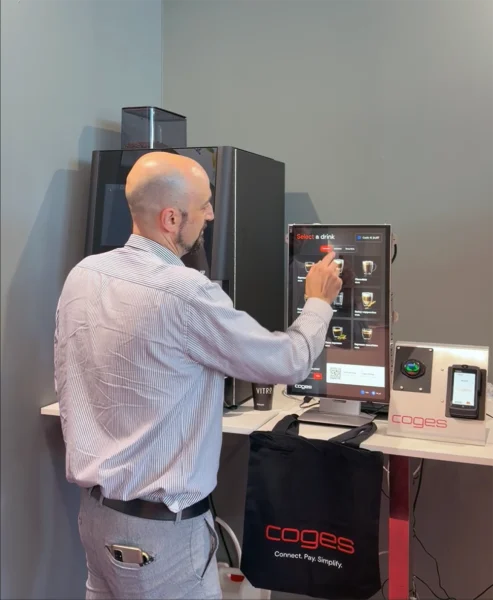
Coges role and SmartLink showcase at Venditalia
Coges was involved in the SmartLink development process from the beginning, joining the European Vending Association working group in June 2024. With 49 years of experience in the vending market, Coges contributed as both a technical partner and market expert.
Before this implementation-oriented group, Coges had already taken part in the earlier EVA working group, started in 2022, which defined the scenarios and technologies behind the protocol. This was also where OPC UA was selected as the technical foundation.
Its role went far beyond consultation.
Coges helped define the practical requirements behind SmartLink and supported its development according to real operator needs. The company acted as a link between vending operators, technology suppliers and EVA, helping translate operator challenges and supplier requirements into technical direction.
This bridge role was important because a communication standard only creates value if it reflects how the market actually works. Operators manage mixed fleets, different machine brands, older and newer technologies, different payment systems, telemetry tools, screens and software platforms. Suppliers need a clear integration path. EVA needed input that connected the technical side with the operational reality of vending.
Coges helped bring these perspectives together.
“SmartLink had to be built around how the vending market actually works,” says Matteo Pegoraro, Coges R&D. “Operators use different machines, different payment systems, different telemetry tools and different software platforms. Our role was to bring this reality into the technical discussion and help define a protocol that can support the whole ecosystem.”
At Venditalia 2026, visitors could see SmartLink in action at the EVA stand through a live Coges showcase. The demonstration connected an Elysium smart screen, a coffee machine, a vending machine, two payment systems and product dispensing in one working setup.
The goal was simple: to show SmartLink in a real vending scenario, not only explain it as a technical specification.
The showcase made the value of SmartLink easier to understand. Visitors could see different parts of a vending environment communicating through a shared standard. For operators, the message was practical: SmartLink is designed to make connected vending easier to build, manage and develop.
What changes for operators?
SmartLink will not replace every existing protocol overnight. The vending market has a large installed base, and many operators will continue working with current systems for years. But SmartLink gives the industry a standard to build toward.
In this transition phase, bridge implementations will be important. Coges’ implementation will support this connection between existing infrastructures and new SmartLink-enabled solutions, helping operators evolve gradually without disrupting current operations.
The biggest change is interoperability.
For operators, interoperability means that machines, payments, telemetry, screens and software can work together with less friction. It means less dependence on isolated or custom integrations. It means more flexibility when choosing equipment and suppliers. It also means connected services can become easier to introduce across a fleet.
SmartLink can support easier system integration because operators and suppliers can work from a shared communication model. This is especially important for mixed fleets, where different machine brands, payment systems and software tools need to operate together.
It can also support better supplier flexibility. Operators should not have to limit their technology choices only because systems are difficult to connect. A common protocol can help reduce this barrier.
SmartLink also creates a stronger base for connected vending services. Remote monitoring, real-time data, interactive interfaces and cloud-connected tools all depend on reliable communication between systems.
Security is another important point. Because SmartLink is based on OPC UA, it can support modern security principles such as secure channels, certificate-based trust and structured data exchange.
For operators, the value of SmartLink is not technology for the sake of technology. It is about making vending systems communicate more easily, integrate more clearly and support future services with less friction.